A front zipper can make a midi skirt look different before you even try it on. In the Romeo + Juliet Couture archive, that zipper runs down the middle of a shape you probably know by heart. Nearby are jeans with embroidery and a blazer that opens at the shoulders. You could describe all three as contemporary, as the label describes its own work. The word gets more interesting when you can point to something on the clothes. In the case of the skirt, the fastening is right there in the design.
On a phone, a photograph of the skirt can pass in a second. You might have opened it between a film listing and a link to the online casino spinanzia. Give the photo another look and see where your eye goes. If it lands on the zipper even when you ignore the styling and the background, you've found a detail the clothes can carry with them.
The word on the shop floor
What is contemporary clothing? In a conversation, it may simply mean clothes that feel current. In retail, contemporary can also name a segment of ready-to-wear. Research from the University of the Arts London places it below established luxury designer labels and notes how easily the boundaries between segments blur. It makes sense as a way to group collections, even if two shops put rather different clothes under that heading. University of the Arts London research
Imagine a navy coat in a contemporary department. The buyer chose where to put it. Now picture an old navy blazer over loose trousers with a long, soft drape. Someone might call that pairing contemporary, too, although the blazer could have been around for years. One use of the word tells you how a store has arranged its clothes. The other tells you something about what the wearer did with them.
| Where the word appears | What it can describe | Look for |
|---|---|---|
| Department sign | A retailer's grouping of labels | Which brands share the floor |
| Collection description | A designer's approach to familiar clothes | Details repeated across pieces |
| Outfit caption | The look of a combination | How the pieces sit together |
| Product listing | A broad style description | Specific notes on cut and fabric |
A familiar shape with one change
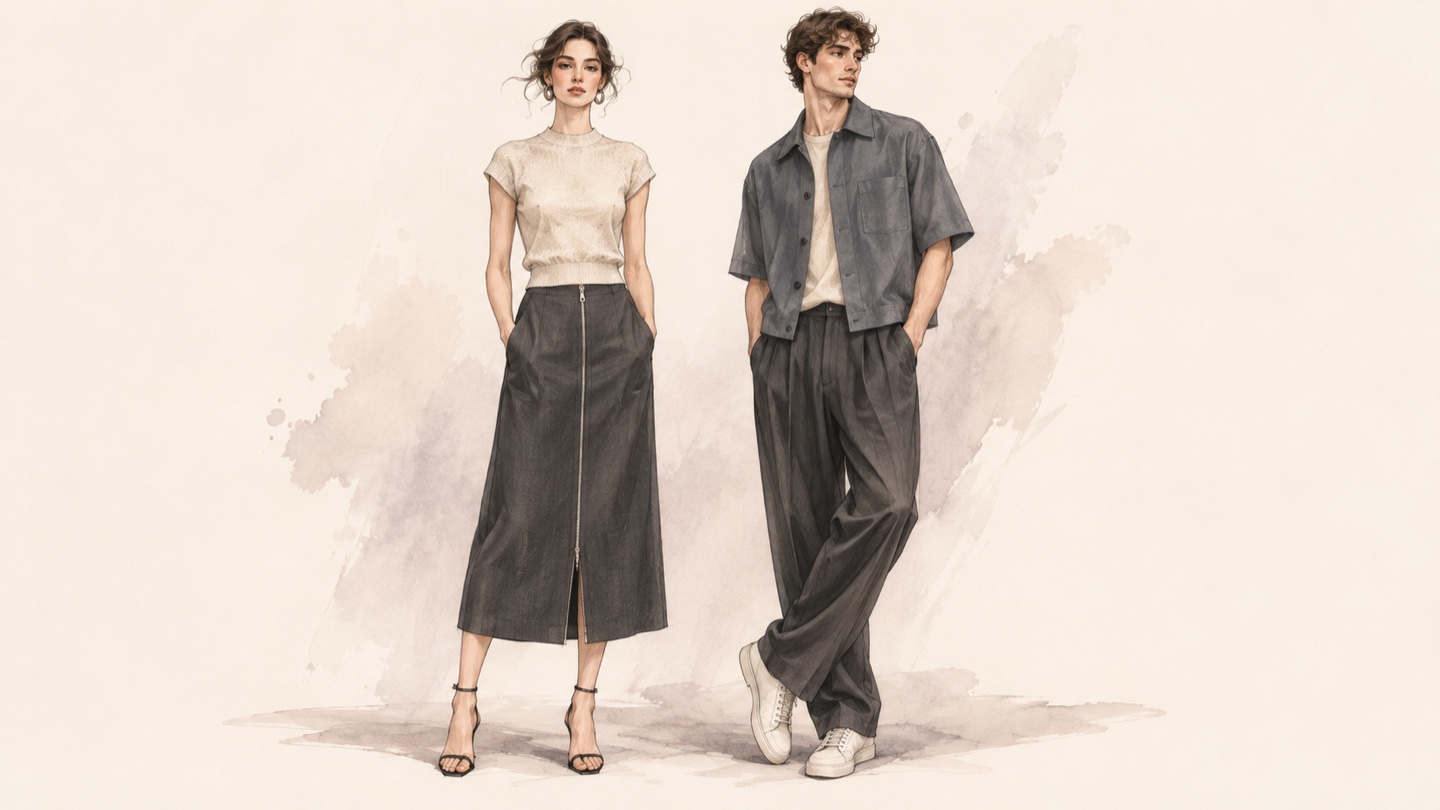
The archived front-zip midi skirt is a small lesson in contemporary women's clothing. A shirt worn loose over it leaves part of the zipper showing, so the eye picks up the line halfway down. Change to a top that ends at the waist and you can follow that line from the beginning. This is the sort of thing a photograph of the skirt on its own can't quite show. The shape stays the same, but you see it differently. Romeo + Juliet Couture shop archive
With the cold-shoulder blazer, the interruption sits higher up. Your eye goes to the openings where it would usually follow the shoulder of a jacket. There’s a useful question here for anyone trying to put words to contemporary style clothing. What part of the garment could you cover up and immediately make it look more familiar? In this archive, a few details are especially easy to spot.
- The point where a hem interrupts a long line.
- The shape of an opening around the shoulder.
- A fastening left visible on the front.
- Embroidery concentrated on one area of denim.
- A contrast between a sheer panel and solid fabric.
The embroidered jeans make the same point in a quieter way. Try picturing them with a plain cotton shirt. There’s a little space around the stitched pattern, enough to see where it begins and where it gives way to denim. With a printed top, the two patterns might share the attention. That could be an interesting outfit in its own right.
The same pair of jeans reads differently once you can see where the embroidery ends.
Where menswear changes the proportions
Men's contemporary clothing often makes its point through proportion. Take an overshirt that ends just above the hips. The trousers get more room in the picture than they would under a longer jacket. If the trousers are full through the leg, you see that width early and follow it down to the shoe. A dark overshirt and dark pants can show the effect perfectly well. You’re looking at the edges and how they meet.
Think about where the parts of the outfit overlap. A jacket can hide a high trouser waist or end just as the waistband comes into view. The meeting of a knit collar and a lapel works on a smaller scale. It may be the first detail you see when the jacket is open. The same comparison works for several pieces that seem quite ordinary on the hanger.
| Familiar piece | Detail to compare | Where it shows |
|---|---|---|
| Overshirt | Body length | Against the trouser waistband |
| Pleated trousers | Width through the leg | Around the knee and shoe |
| Knit polo | Collar shape | At the neck under a jacket |
| Work jacket | Pocket scale | Across the chest or hips |
A still photo has its limits here. The overshirt may hang close to the body until the wearer reaches across a table. Then the back lifts and the sides open out. A few seconds of movement can tell you something about the shape that a clean front view misses.
When the colors are close, the cut is easier to see.
How a brand finds its handwriting
Look at several pieces together and contemporary clothing brands start to show their habits. In the Romeo + Juliet Couture archive, a lace dress uses texture to draw the eye, while a shoulder opening puts the focus on a gap. The embroidered denim finds another way to draw attention to one area. That interest in where a detail lands gives you something more specific to recognize than the word on the shop sign.
Try describing one piece to somebody who hasn't seen it. “Contemporary” won't give them much to picture. “A boxy jacket with pockets that sit low on the front” gets them closer. After a few descriptions like that, you might find that the pieces you remember have something in common. It could be the way their hems fall or the amount of empty space around a detail.
- Look at where the shoulder seam sits.
- Compare one jacket's length with another's.
- Notice which textures recur across a collection.
- Trace where the eye goes when a detail catches it.
- Picture the piece beside one garment you already wear.
The meaning of contemporary clothing shifts with the setting. In a store, it can help you find a group of labels. Once you’ve picked up a garment, you can get much closer to what the designer had in mind. Go back to that skirt. A zipper is a routine thing to put in one. Bringing it around to the front gives it a place in the way you see the whole skirt.